The Celestial Dance of Nut and the Milky Way: A Cosmic Connection
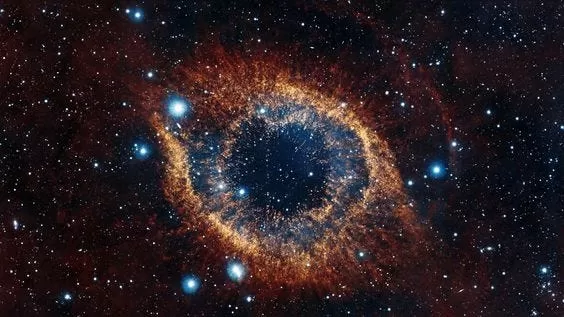
For the ancient Egyptians, the night sky was not just a beautiful expanse of darkness sprinkled with twinkling stars; it was a canvas for their rich mythology and beliefs. Central to this celestial tapestry was Nut, the goddess of the sky. A recent study suggests a fascinating link between Nut and one of the most awe-inspiring features of the night sky: our galaxy, the Milky Way.
In Egyptian mythology, Nut is depicted as a woman arched over the earth, her body adorned with stars. The Sun god Ra travels across her each day, symbolically disappearing into her mouth at sunset and being reborn at dawn from between her legs. While this symbolic connection to the sky was known, the specifics of Nut's link to astronomical features remained a mystery.
Dr. Or Graur, an astrophysics professor at the University of Portsmouth, delved into this mystery. Using astronomical simulations, he compared ancient Egyptian descriptions of Nut with the night sky's appearance during different seasons. The findings were compelling: during summer nights, the Milky Way's orientation mirrored Nut's torso, stretching from northeast to southwest. In winter, the Milky Way shifted to align with Nut's outstretched arms, running from northwest to southeast.
However, Graur suggests that the Milky Way's alignment with Nut was more symbolic than literal. While Nut represented the eternal sky against which celestial bodies moved, the Milky Way's position changes hourly due to Earth's rotation. Thus, the shifting Milky Way served as a symbolic representation of Nut, highlighting different aspects of her at various times.
This connection between Nut and the Milky Way is not unique to Egyptian mythology. Similar themes exist in cultures worldwide. Many cultures, from the Eastern Pawnee of North America to the Navajo, Maya, and even the Baltic region of Europe, view the Milky Way as a path to the afterlife. In Egyptian belief, Nut was associated with the afterlife, ingesting the Sun each night and giving birth to it at dawn—a cycle resembling death and rebirth.
Additionally, Graur's research revealed that Nut was linked to the autumn bird migration in Ptolemaic Egypt. Birds arriving from Eurasia in the fall were said to emerge from the Duat, the Egyptian underworld—a concept reminiscent of Baltic myths where birds followed the Milky Way on their southward migration.
While caution is needed when drawing parallels between distant cultures, Graur's research offers intriguing insights into how ancient civilizations interpreted the cosmos. The night sky's vastness and the boundless human imagination mean that similarities can arise by coincidence. Still, the shared themes surrounding the Milky Way across cultures hint at a universal human fascination with this celestial phenomenon.
In a statement, Graur emphasized the interdisciplinary nature of his research, highlighting how combining astronomy and mythology can offer fresh perspectives on ancient beliefs. He views this study as a starting point for a broader project cataloging the multicultural mythology of the Milky Way.
As we gaze up at the Milky Way today, we are participating in a tradition that spans millennia. Connecting with this celestial view links us not only to the ancient Egyptians but also to humanity's enduring fascination with the cosmos. Nut's embrace may no longer arch visibly above us, but her celestial dance with the Milky Way continues to inspire wonder and connection across cultures and time.