China Embarks on Historic Mission to Retrieve Moon Samples from Far Side
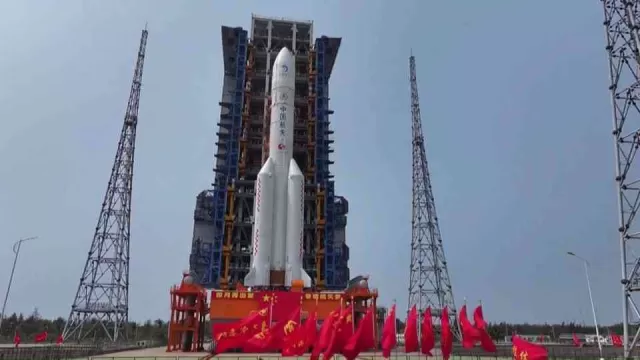
In a pioneering effort, China has initiated an ambitious mission to collect rocks and soil from the far side of the moon, marking a significant milestone in lunar exploration. The Long March-5, China's largest rocket, took off from the Wenchang Space Launch Center in Hainan, carrying the Chang'e-6 probe on a nearly two-month journey.
Weighing over 8 metric tons, the Chang'e-6 probe aims to land in the South Pole-Aitken Basin on the moon's far side, an area concealed from Earth's view. Once on the lunar surface, it will gather samples before returning them to Earth, providing scientists with a rare opportunity to study the geological composition of this mysterious region.
This mission represents another notable achievement in China's expanding lunar and space exploration program. In recent years, China has made significant progress in lunar exploration, with successful missions including the unmanned landing of Chang'e-4 on the far side in 2018 and the retrieval of lunar samples by Chang'e-5 in 2020.
Attended by scientists, diplomats, and space agency officials from various countries, the launch of Chang'e-6 underscored international interest in lunar exploration. Notably absent from the collaboration was the United States, as China is barred by U.S. law from cooperating with NASA.
The scientific objectives of Chang'e-6 are diverse, with researchers eager to gain insights into the moon's geological history. By analyzing samples from the South Pole-Aitken Basin, scientists hope to deepen their understanding of the moon's formation and evolution over billions of years.
Moreover, Chang'e-6 is part of a broader initiative to establish a permanent research station on the moon, known as the International Lunar Research Station (ILRS). Led by China and Russia, the ILRS aims to facilitate deep space exploration and harness the moon's potential as a resource-rich celestial body.
The construction of a lunar research station holds immense promise for future scientific endeavors, fostering international collaboration and the exploration of lunar resources. As nations around the world turn their attention to the moon, the pursuit of knowledge and discovery continues to propel humanity's exploration of the cosmos.
With Chang'e-6 poised to unveil new secrets hidden beneath the lunar surface, China reaffirms its commitment to pushing the boundaries of space exploration and unlocking the mysteries of the universe. As the mission unfolds in the coming weeks, the world eagerly awaits the groundbreaking discoveries that lie ahead.